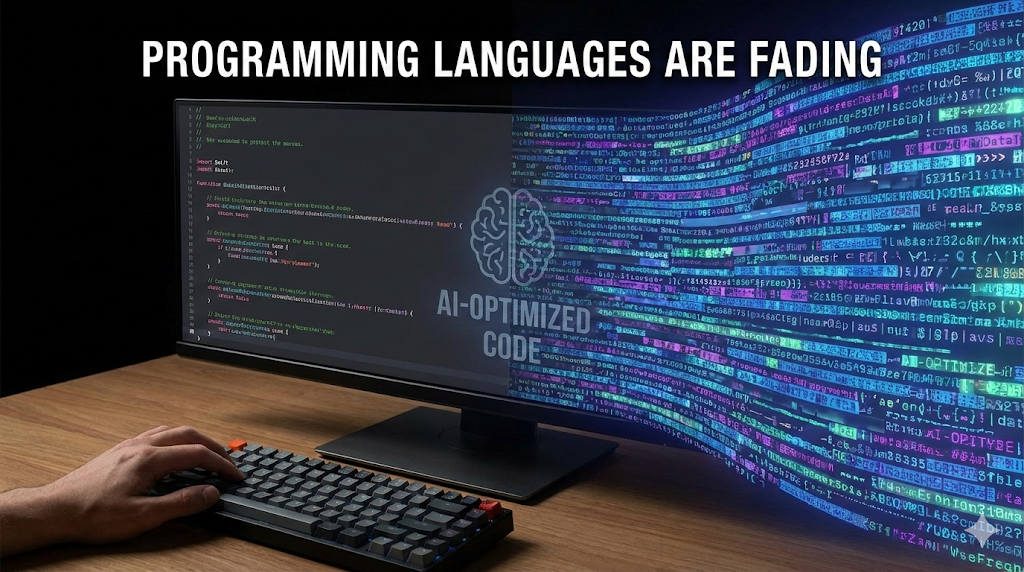
Programming Languages Are Fading — At Least in the Form We Recognize

AI-Optimized Code

TL;DR

  • If AI writes, reads, and maintains most code, programming languages will evolve for machines, not humans.
  • We may be the last generation that writes code meant to be read.
  • The shift isn’t dramatic—it’s already happening in small, practical ways.

Steve Yegge and Gene Kim gave a talk recently about how IDEs are drifting toward irrelevance. Do yourself a favor and go watch it. They also revisit something Erik Meijer said years ago: we might be the last generation that ever types code. Back then it sounded bold. Today it feels… reasonable.

I’ve been coding for more than forty years. For most of that time, the rule was simple: write code for other developers and for your future self. The computer doesn’t care.

But while building two new apps with Claude Code and Codex, something shifted. After adding a batch of features, my old instinct kicked in: time to refactor, clean up, make it readable. Except—readable for whom?

I wasn’t reading the code. AI wrote it, tested it, explained it, refined it. My job was to describe what I needed.

So I tried an experiment.

I asked the AI to write code optimized not for humans, but for itself.

The result looked like a compressed, almost-obfuscated form of JavaScript—dense, compact, efficient for token limits, context windows, and parsing. In other words: code shaped for a machine, not a human eye. And it worked beautifully.

That felt like a small preview of what’s coming. If AI becomes both the producer and consumer of most code, why would programming languages stay optimized for us? They’ll tilt toward forms that machines can parse, transform, and reason about efficiently. We may still “decompile” them for understanding, but the native form won’t be written with human readability in mind.

This doesn’t mean human coding disappears. There will always be people who write software the way watchmakers build watches—slowly, deliberately, for the craft of it. But the center of gravity is shifting.

More on this soon. The interesting question isn’t whether programming languages are dying—it’s what they’re becoming when humans aren’t the primary audience anymore.

Two Weeks with Vibe Coding (And Why I’m Still Excited)


TL;DR

• In just two weeks, I used AI-powered “vibe coding” to build real apps faster than ever before.
• It’s not about magic prompts—it’s about treating AI like a dev team.
• The approach works best when you go step-by-step and stay in the loop.


I’ve had a bit more time lately, and in just two weeks of diving into AI, I’ve learned more than I had in the past few years. It’s been both exciting and surprisingly productive. One thing that really stood out: vibe coding.

It’s still a bit of a buzzword, sure—but the idea is surprisingly solid. Instead of writing code line by line, you describe what you want, and the AI fills in the rest. It’s not magic, and it doesn’t always get things right. But if you know what you’re doing, this approach can make the development process feel fresh again—less about syntax, more about shaping and evolving ideas.

Over the past couple of weeks, I’ve built two small apps using this approach:

  • A Node.js + Svelte recipe book app
  • A Python app for ReMind, my AI journaling tool

Each one took about two hours to get into shape. To put that in perspective: I’ve been coding for decades. Even with my experience, building those same apps solo would take 2–3 days each. That’s a serious productivity gain.

And no, I don’t believe in the meme: “Let AI generate code in 5 minutes, then spend a year fixing bugs.” That’s not how I use it—and not how I think it should be used. In fact, the way I work with AI mirrors how I’ve led real development teams:

  • Start with structure
  • Build base classes and core functionality
  • Test, review, iterate

Same with AI: give it a piece at a time, step through the logic, review and refine. The feedback is instant, but the thinking behind it is the same.

Demos like the GitHub Copilot Agents video help (like this one), but they also oversimplify things. The demo shows feeding in all the requirements at once and generating the whole app. That’s not how sustainable, maintainable software gets made.

You can even work with multiple AIs at once. On the Node.js + Svelte app, I had one AI doing backend, another doing frontend—they weren’t stepping on each other. Meanwhile, I had a Swift agent off doing something else entirely. It felt like managing a small team that never sleeps and doesn’t argue about code style.

I’m not tied to a specific model. I’ve used GitHub Copilot Agent—it’s fast and slick, but VS Code isn’t my preferred IDE. I’m a fan of JetBrains tools like WebStorm, and they’ve just released Julie—an AI agent that can run unit tests as it applies changes. It’s slower than Copilot for now, but promising.

I’m genuinely excited. When it’s done right, this approach can really speed things up—especially for new projects. It may be more challenging to retrofit into large legacy codebases (I’ll test that next), but the potential is real.

More on this soon—especially on how to collaborate well with AI developers. That’s where the real power kicks in.